
For thousands of vulnerable households, access to government entitlements is not just a benefit, it is a lifeline. Food rations ensure daily survival, pensions provide dignity in old age, and health insurance protects families from financial shocks. Yet, for many communities in rural and Adivasi India, these entitlements remain out of reach not because they are ineligible, but because the system is difficult to navigate.
This reality is especially stark in the northern districts of Surguja, Koriya, and Manendragarh-Chirimiri-Bharatpur in Chhattisgarh. Characterized by remote, forested, and geographically dispersed habitations, many villages and hamlets are located far from block and district headquarters, with limited transport and connectivity. Home to Adivasi and Particularly Vulnerable Tribal Groups (PVTGs), these hard-to-reach regions face compounded challenges limited awareness, lack of documentation, and complex administrative processes. For women-headed households, the elderly, persons with disabilities, and landless families, these barriers often translate into persistent exclusion from essential services and welfare benefits.
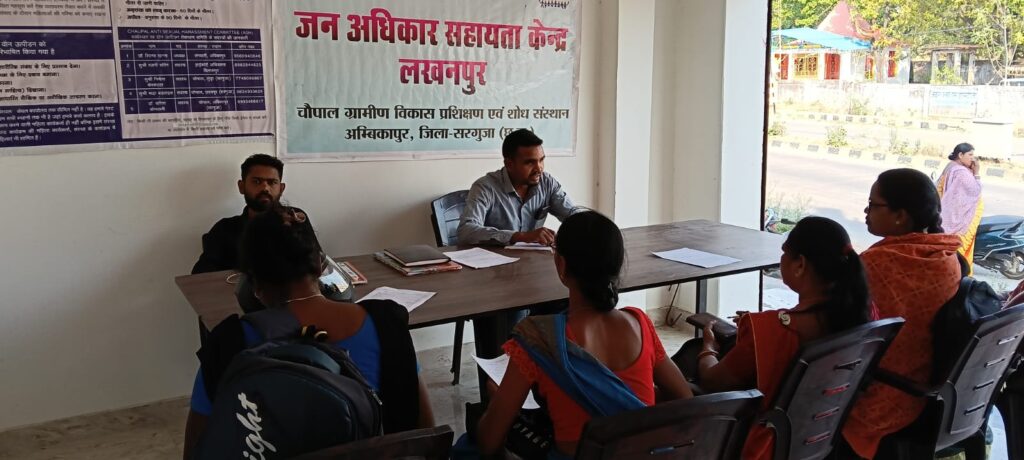
For over two decades, Chaupal has been working alongside these communities to strengthen their access to rights and entitlements. Building on this experience, Chaupal launched Jan Adhikar Sahayata Kendras (Public Assistance Centres) in 2019 across six blocks bringing critical support closer to those who need it most, especially in remote and underserved locations.
These Kendras are more than service points they are trusted community spaces where people find guidance, support, and assurance. At the Kendras, individuals receive hands-on assistance to apply for essential documents such as Aadhaar cards, Caste and Income certificates, Ration cards, Ayushman cards, and Birth and Death certificates. They are also supported in accessing key welfare schemes, including pensions (widow, old age, disability), scholarships, PDS, PM-KISAN, and other social security schemes like PMJJBY and PMJSBY.
What sets the Kendras apart is their commitment to walking the entire journey with the community from identifying eligibility to application, follow-up, and resolution. This sustained, last-mile engagement is particularly critical in remote geographies, where even a single visit to a government office can involve significant time, cost, and effort. By reducing these barriers, the Kendras ensure that distance and isolation do not prevent access to rights.
The results are both tangible and transformative. Since 2019, Jan Adhikar Sahayata Kendras have facilitated 11,470 applications and claims (As on 31st March 2026):
- 10,410 successfully resolved, enabling thousands of families to access critical entitlements
- 377 applications in progress, reflecting continuous follow-up and support
- 683 applications pending, underscoring systemic challenges that require ongoing engagement
Behind these numbers are stories of real change, elderly individuals receiving pensions for the first time, families accessing affordable healthcare, and workers securing identity and social security benefits. For many, this has meant reduced vulnerability, improved financial stability, and a renewed sense of dignity.
Equally important is the shift in how communities engage with governance systems. The Kendras have reduced dependence on middlemen, improved awareness of rights, and empowered individuals to claim what is rightfully theirs. Community members who once felt excluded often due to distance and inaccessibility now approach public systems with greater confidence.
Today, Jan Adhikar Sahayata Kendras stand as a powerful example of how community-based facilitation can strengthen last-mile governance, especially in remote and hard-to-reach areas. By addressing critical gaps awareness, documentation, and sustained handholding, Chaupal is not only improving access to services but also reinforcing accountability within public systems.
This initiative goes beyond delivering schemes. It is about restoring dignity, enabling inclusion, and ensuring that the promise of welfare reaches every eligible household no matter how remote or difficult the terrain.