
Environment and Climate Change
Northern Chhattisgarh’s Adivasis face climate challenges; Chaupal promotes sustainable resource management and community‑led, climate‑resilient livelihoods.
Northern Chhattisgarh is characterized by dense forests and a large population of Adivasi communities whose livelihoods are closely linked to forests, land, and water resources. However, increasing climate variability, degradation of natural resources, and limited institutional support have made forest-dependent communities more vulnerable. Forest degradation, frequent wildfires, loss of indigenous species and decreasing volume of NTFP (e.g. Tendu Patta, Mahua) further weaken ecosystem resilience and livelihoods. Shifts in monsoon patterns have disrupted traditional farming, especially for smallholders reliant on paddy and millets. The resulting livelihood insecurity, malnutrition, and ecological decline highlight a need for community-led, climate-resilient governance and sustainable resource management.

Current Projects
Community-led Forest Governance
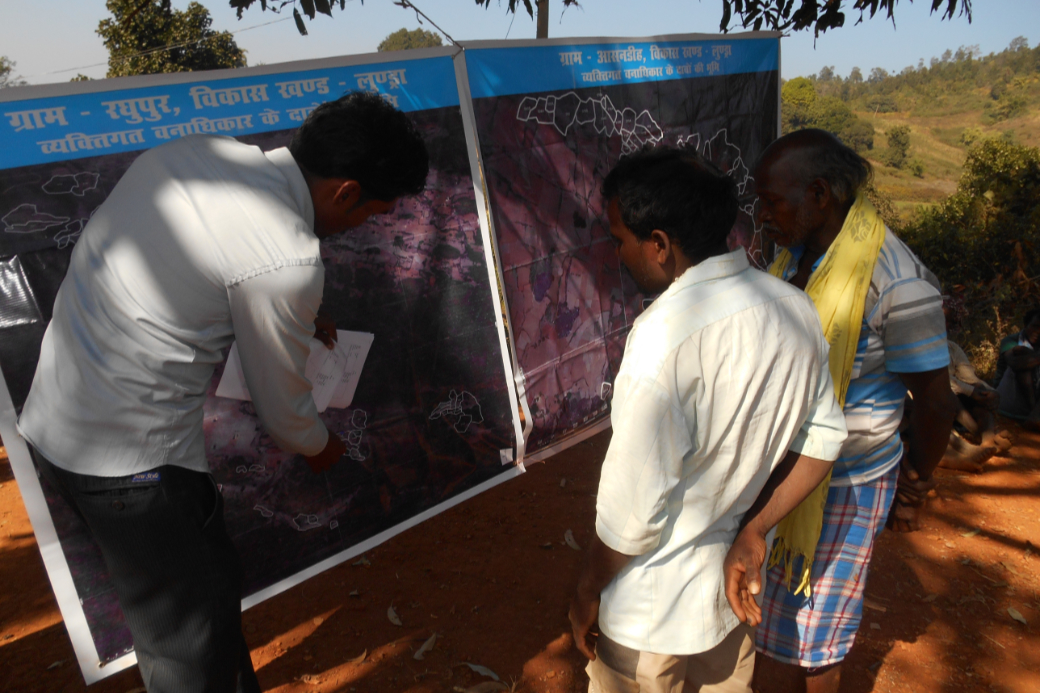
Chaupal’s environment and climate initiatives focus on strengthening community-led forest governance and sustainable natural resource management under the Forest Rights Act, 2006, which recognizes the rights of forest-dwelling communities over Community Forest Resources (CFRs) and assigns Gram Sabhas a key role in their protection and management. Across northern Chhattisgarh, Chaupal is working with more than 200 Gram Sabhas where CFR rights have been recognized, supporting the formation and strengthening of Community Forest Resource Management Committees (CFRMCs). Through awareness generation, capacity building, participatory planning, and GIS-based mapping of traditional forest boundaries, communities are enabled to prepare and implement CFR conservation and management plans. These plans guide activities such as soil and water conservation, nursery development and plantation of indigenous species, wildfire prevention, sustainable harvesting of non-timber forest produce, revival of traditional systems like Thengapalli, and improved management of grazing areas and water bodies. The initiative aims to support communities in conserving and sustainably managing large forest areas, strengthening biodiversity, climate resilience, and livelihood security for Adivasi populations.
GROW Project Supported by GROW+
The Climate Action initiative focuses on strengthening Chaupal’s institutional capacity while advancing community-led climate resilience and sustainable natural resource management in northern Chhattisgarh. The initiative integrates a climate perspective into ongoing work with Adivasi communities, Gram Sabhas, and Community Forest Resource Management Committees (CFRMCs), enabling better forest conservation, resource management, and adaptation to climate change. It emphasizes capacity building of both communities and the organization on climate action frameworks, forest conservation, and soil and water management. Through workshops, knowledge-sharing platforms, and collaboration with government and civil society, the program supports Gram Sabhas in managing their Community Forest Resources. Activities such as seed ball campaigns, forest regeneration, and improved resource management contribute to biodiversity conservation, ecosystem restoration, and sustainable livelihoods.
