
Rights Restored, Lives Rebuilt
Ensuring Forest Rights for Pahadi Korwas in Surguja

Forest-dwelling communities, over centuries, have maintained a sacred relationship with the land, not only for their livelihood, but also for their very identity and rootedness. Yet, for decades, these communities remained at the receiving end of exclusion and denied their rightful claim to the lands they cultivated and cherished. With the enactment of the Scheduled Tribes and Other Traditional Forest Dwellers (Recognition of Forest Rights) Act, 2006 (FRA), attempts were made to redress this historic injustice with the recognition of Individual and Community Forest Rights (IFR and CFR).
Despite this groundbreaking law, the spirit of the FRA has far from been realised. As of December 2025, out of a total of 8.90 lakh individual forest rights claims filed in Chhattisgarh, only 4.81 lakh individual rights claims have been recognised, with almost 46% of the claims being rejected or still pending. The gap between policy and practice is palpable, and it is the marginalised communities who bear the weight of it.
This is the context within which we met the Pahadi Korwas, a Particularly Vulnerable Tribal Group (PVTG) in the rugged, hilly terrain of the Surguja district in northern Chhattisgarh. Villages like Bhakurma, located in the Udaipur Block of Surguja, were representative of the stark realities of the most marginalised sections of society. Isolated by geography and the systemic lack of intervention, these communities have very little or no access to the formal systems and consequently lack any understanding of their entitlements and rights, with as low as 0.6% literacy in certain pockets. The absence of any record of their rightful claims led to an easy rejection of individual claims.
It was in this context that Chaupal Gramin Vikas Evam Prashikshan Sanstha came forward to build the missing bridge between rights and reality. The organisation adopted a targeted approach to reach out to the Pahadi Korwas. In a bid to overcome the crucial gap in documentation, Chaupal organised GPS-based mapping of individual agricultural and residential land rights for Pahadi Korwas. With precise accuracy, Chaupal surveyed the cultivable and residential land rights of 1873 PAHADI KORWAS Households in Surguja district, and collected the GPS-based proof of occupation on or before 13th December, 2005. This has made claims strengthening relatively simpler and has added a stronger legal basis to the claims being filed.
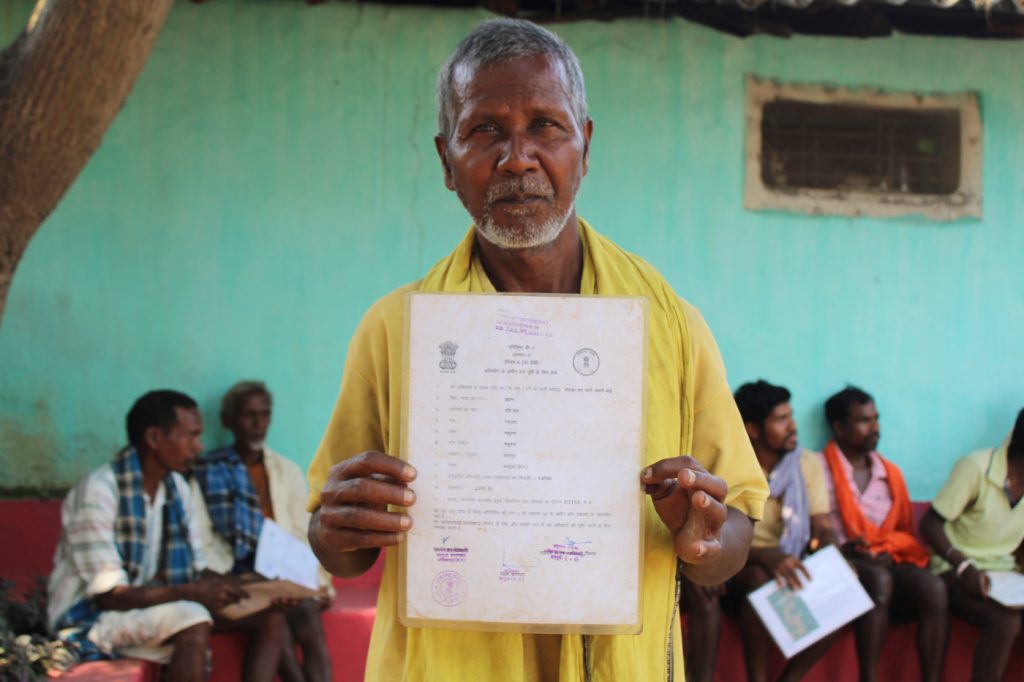
Meanwhile, Chaupal had organised several Gram Sabha meetings, training and orientation workshops to sensitise the community members and make them aware of the various provisions under the FRA. A systematic and continuous process was undertaken in the community through handholding of community-based structures like Forest Rights Committees (FRCs) and awareness training for members of the Gram Sabha. They were informed of the entire process of claim filing, claim forms, their verification by the Forest Rights Committee and onward submission to the competent authority for final approval.
Through a successful and focused intervention, 1480 PAHADI KORWA Households received their Individual Forest Rights (IFR) claims, with a good number of PVTG households, like those from Bhakurma village, getting titles in 2022. It is much more than just the document of land ownership. It’s a journey of regaining self-respect, securing a stable livelihood and opening a window for future betterment.
This project is a testament to how the right combination of intervention through technical skills, information dissemination and capacity building can bring about a real change and prove to be an instrument of empowerment for the marginal communities of the country. It ensures that no one is leſt behind when policies that are created with a view to empowering specific sections reach out to and make a meaningful difference in the lives of all concerned. By restoring land rights, Chaupal is not only implementing an act, but it is rebuilding lives.