
Bringing Rights Closer
Jan Adhikar Sahayata Kendras in Surguja
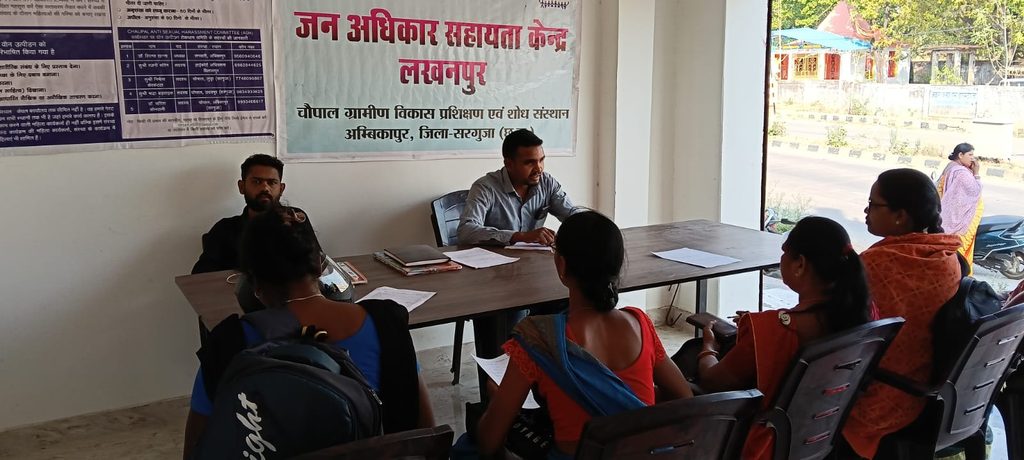
For many families in rural areas, government schemes are not just benefits; they are what keep the household going. A ration card means food on the plate, a pension brings some dignity in old age, and an Ayushman card can protect a family from heavy medical expenses. But for many Adivasi communities in Surguja, Koriya, and Manendragarh-Chirimiri-Bharatpur, accessing these has never been simple. Villages are far, transport is limited, and the process itself can feel confusing. Many people don’t have the required documents or don’t know where to start. For an elderly person, a widow, or a daily wage worker, even one trip to a government office can mean losing a day’s income. So, despite being eligible, many were left out.
For over two decades, Chaupal has been working alongside these communities to strengthen their access to rights and entitlements. Building on this experience, Chaupal launched Jan Adhikar Sahayata Kendras (Public Assistance Centres) in 2019 across six blocks, bringing critical support closer to those who need it most, especially in remote and underserved locations.
These Kendras are more than service points; they are trusted community spaces where people find guidance, support, and assurance. At the Kendras, individuals receive hands-on assistance to apply for essential documents such as Aadhaar cards, Caste and Income certificates, Ration cards, Ayushman cards, and Birth and Death certificates. They are also supported in accessing key welfare schemes, including pensions (widow, old age, disability), scholarships, PDS, PM-KISAN, and other social security schemes like PMJJBY and PMJSBY.
This has made a real difference. Since 2019, the Kendras have helped with 11,470 applications, out of which 10,410 have been completed, 377 applications are in progress, reflecting continuous follow-up and support, 683 applications are pending, underscoring systemic challenges that require ongoing engagement. But beyond the numbers, it’s about people, elderly individuals receiving pensions for the first time, families accessing healthcare through Ayushman, and workers finally having the documents they need.
There is also a change in how people see the system. Many are now more aware of their rights and more confident in approaching government offices. Dependence on middlemen has reduced, and people are slowly learning to navigate things on their own. What these Kendras have really done is simple: they have made the system a little easier to reach, and in doing so, brought dignity and confidence back into people’s lives.