
Entitlements and Governance
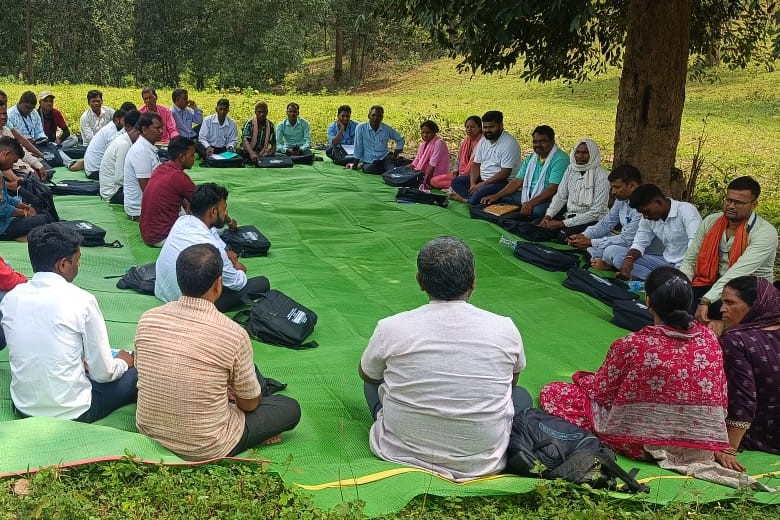
Chaupal strengthens grassroots governance in northern Chhattisgarh, empowering tribals to claim rights, manage resources, and access entitlements.
Adivasi communities in the Scheduled Areas of northern Chhattisgarh have long managed their lands, forests, and natural resources through community institutions and customary practices. Over time, evolving administrative systems, development priorities, and regulatory frameworks have influenced the functioning of these traditional governance structures. As a result, in some areas the role of community institutions in local decision-making and natural resource management has become less prominent, which can affect the ability of communities to fully exercise the rights and responsibilities provided under existing constitutional and legal provisions. The Forest Rights Act and the Panchayat (Extension to Scheduled Areas) Act represent historic legal commitments by the Indian state to correct historical injustices against Adivasi communities. These laws recognize the authority of Gram Sabhas to manage forest resources, protect biodiversity, regulate minor forest produce, and decide development priorities. Yet, in practice, the promise of these laws remains only partially realized.
Across many tribal villages, Gram Sabha’s are not fully empowered to exercise their decision-making authority. Community forest rights remain unrecognized in several areas, and local institutions often lack the information, technical support, and administrative backing required to govern natural resources effectively. Development projects frequently proceed without meaningful consultation with Gram Sabhas, undermining both democratic governance and community rights.
Access to livelihood and welfare schemes also remains uneven. Programs such as the Mahatma Gandhi National Rural Employment Guarantee Act often face challenges including irregular availability of work, delays in wage payments and weak planning processes at the Gram Panchayat level. At the same time, many eligible households face barriers in accessing essential welfare schemes such as the Public Distribution System, pensions and scholarships due to documentation gaps, administrative complexities, and limited digital access.
These governance and service delivery challenges are further compounded by geographical isolation, low literacy levels, and limited awareness of rights and entitlements. Strengthening grassroots governance, improving community awareness, and enhancing accountability in public systems is therefore critical to ensure that Adivasi communities can access their legal rights, livelihoods and social protection entitlements.
Projects
The Local Self Governance Project
Chaupal’s Governance and Entitlements Initiative supported by Azim Premji Foundation works across nearly 400 villages in the northern districts of Surguja, Surajpur, Balrampur, Korea and MCB in Chhattisgarh, inhabited by Adivasi communities such as Pahadi Korwa, Oraon, Gond, Kanwar, Pando, Korwa, Manji, Majhwar, Saunta and Nageshia. The project focuses on strengthening inclusive local governance while ensuring that vulnerable households can access their rights and public entitlements. The initiative supports improved implementation of key legislations and welfare systems including the Forest Rights Act, the Panchayat (Extension to Scheduled Areas) Act, the Mahatma Gandhi National Rural Employment Guarantee Act and the Public Distribution System.
The project aims to improve the lives of Adivasi communities by strengthening local governance institutions and ensuring better access to rights and entitlements. Community-based assistance mechanisms will support households in resolving issues related to welfare schemes and essential documentation, enabling them to access social protection, food security programmes and public services more effectively. The initiative will also support the recognition of individual and community forest rights under the Forest Rights Act, helping forest-dependent communities secure tenure over traditional lands and strengthen community-led forest governance. With recognized rights, Gram Sabhas will be better positioned to implement conservation and management plans for community forest resources, promoting sustainable forest management and livelihoods.
The project will also facilitate improved access to wage employment under the Mahatma Gandhi National Rural Employment Guarantee Act, contributing to greater income security for rural households. At the governance level, the initiative will strengthen village and hamlet-level institutions in Scheduled Areas in line with the Panchayat (Extension to Scheduled Areas) Act, enabling Gram Sabhas to play a stronger role in local planning, natural resource management and monitoring of public schemes.
Together, these efforts will lead to more responsive local governance, stronger community institutions and improved access to rights, entitlements and livelihood opportunities for Adivasi communities.